BS 7671 Amendment 4: What Changes for Homeowners
The UK wiring regulations were updated in 2026. Here is what Amendment 4 changed, what it means for your home, and why your existing wiring has not suddenly become illegal.
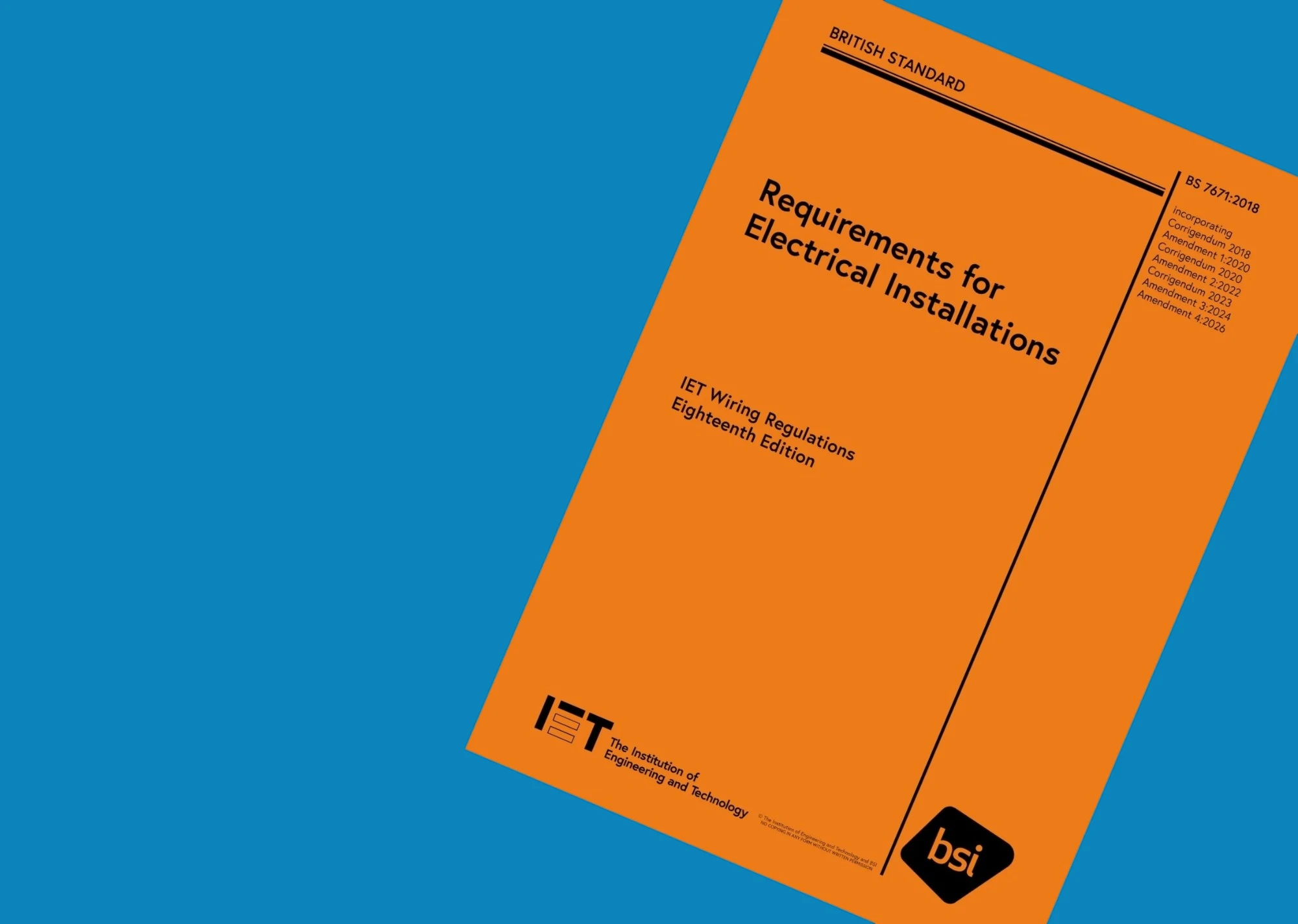
The UK wiring regulations, BS 7671, were updated in 2026 with Amendment 4. Since 15 October 2026 it has been the only current version, so any electrical work or inspection in your home is now carried out against it.
If you have seen headlines about "new electrical rules", you might be wondering whether you need to do anything. For most homeowners the honest answer is no. Here is what actually changed, what did not, and where it might affect you.
What Is BS 7671?
BS 7671 is the British Standard for electrical installations, published jointly by the IET (Institution of Engineering and Technology) and BSI. Electricians often call it the "18th Edition" or simply "the regs".
It sets out how new electrical work should be designed, installed, inspected and tested. Every few years it is updated through an amendment, to keep up with new technology and lessons learned. The full current title is BS 7671:2018+A4:2026, which means the 18th Edition (2018) with Amendment 4 (2026).
Key Dates
- 15 January 2026: the IET and BSI announced Amendment 4
- 15 April 2026: Amendment 4 was published and could be used straight away
- 15 October 2026: the previous version (BS 7671:2018+A2:2022+A3:2024) was withdrawn, leaving Amendment 4 as the only current version
During the six months in between, electricians could work to either version. Work that was designed before 15 October 2026 can still be completed to the previous version, but anything new from that date is designed and certified to Amendment 4.
Does My Existing Wiring Need Upgrading?
No, not just because the standard has changed. This is the single most important point for homeowners.
BS 7671 applies to new work: new installations, additions and alterations. It is not applied backwards. An installation that was put in correctly to an earlier edition does not become illegal, unsafe or non-compliant overnight because a new amendment is published.
That has always been the case. Every amendment brings in new requirements, and most homes in the UK were wired to older editions. What matters is whether the installation is safe and in good condition, not whether it matches the very latest version line for line.
What it does mean:
- Any new work in your home, such as a new circuit, a consumer unit upgrade or an EV charger, must meet Amendment 4
- Alterations to an existing circuit must be done to the current standard, and the electrician must check that the existing installation can safely support the change
- Inspections (EICRs) are now carried out with reference to Amendment 4
How EICRs Work Under Amendment 4
An Electrical Installation Condition Report (EICR) checks the condition of your existing installation. The inspector records anything that needs attention using codes:
- C1: danger present
- C2: potentially dangerous
- C3: improvement recommended
- FI: further investigation advised
The key thing to understand is that an EICR is not a test of whether your home matches the latest regulations. The inspector compares your installation against the current standard, but the codes are about safety. Something that simply does not meet the newest requirements, but is not dangerous, would normally be a C3 at most, or not coded at all.
The IET has made this point itself. In its Wiring Matters magazine, it notes that an installation not being to current standards does not necessarily mean it is unsafe.
The Big EICR Change: FI Codes
Amendment 4 made one change that does affect homeowners and landlords directly. An FI code no longer makes an EICR "unsatisfactory".
Under the previous version, if the inspector found something they could not fully investigate during the visit and gave it an FI code, the whole report was marked unsatisfactory. Under Amendment 4:
- C1 and C2 codes still make the report unsatisfactory
- C3 and FI codes do not affect the overall outcome
- The FI wording has changed from investigation being needed "without delay" to "further investigation is advised"
You should still act on an FI. It means the inspector saw something that needs a closer look. But a single FI will no longer turn an otherwise sound report into a fail.
If you are a landlord, this is worth knowing because an unsatisfactory report triggers remedial deadlines under the rental regulations. Our guide on what an EICR is and whether you need one covers the basics.
The Main Technical Changes
Most of Amendment 4 is aimed at electricians and designers. The headline additions from the IET are:
- A new chapter on stationary batteries: home battery storage, with or without solar panels
- Protective Neutral Bonding (PNB): a type of earthing arrangement used on some supplies, now recognised in BS 7671 for the first time
- More options for adding low carbon technology to switchgear, such as connecting solar PV to new and existing consumer units
- Functional earthing for IT equipment and a new section on Power over Ethernet (data cables that also carry power)
- A major revision of the rules for medical locations, such as hospitals and clinics
Here is what the ones relevant to homes mean in practice.
Home Battery Storage
This is the biggest change for homeowners. Batteries are becoming common alongside solar panels, and Amendment 4 adds a dedicated chapter for them. It covers how battery systems are designed and protected, including the inverters that let power flow both ways, and it puts a strong emphasis on where a battery is located, ventilation and reducing fire risk.
If you are planning a battery, the location matters more than it used to. Do not assume the loft or a cupboard under the stairs will be acceptable. Your installer should explain where it can safely go and why.
Solar Panels and Your Consumer Unit
Connecting solar PV or a battery to an existing consumer unit has always needed care, because the board has to handle current from both the grid and the generation. Amendment 4 gives electricians more options for doing this with both new and existing switchgear.
For you, that may give a little more flexibility when adding solar or a battery to an existing board. Whether your current consumer unit is suitable depends entirely on the board itself, and your electrician will need to check it.
PNB Earthing
Most homes do not need to know about this. PNB is an earthing arrangement used on some supplies, typically where a small number of properties share a local transformer. It is now formally recognised in BS 7671 and can be recorded on certificates. If it applies to you, your electrician will identify it.
What About AFDDs, RCDs and Surge Protection?
You may have heard about arc fault detection devices (AFDDs), RCD protection and surge protection devices (SPDs) in the context of new regulations. These were mainly dealt with in earlier amendments, especially Amendment 2 in 2022, rather than Amendment 4. Those requirements are still in place:
- RCD protection is required for socket outlets rated up to 32 amps, with limited exceptions
- Surge protection is required where a voltage surge could cause serious injury, affect safety services such as fire alarms, or cause significant financial or data loss. In practice this means most new consumer units include an SPD
- AFDDs are required on socket circuits in certain buildings: high-rise residential buildings, houses in multiple occupation (HMOs), purpose-built student accommodation and care homes
Amendment 4 updated the wording on AFDDs. What used to be called "higher risk residential buildings" are now "high-rise residential buildings", broadly buildings of 18 metres or more, or seven or more storeys. For an ordinary house, AFDDs are not a blanket requirement, but your electrician may discuss them with you as an option.
If you are thinking about replacing an old fuse box, our guide to consumer unit upgrades explains what a modern board includes and why.
What About EV Chargers?
EV charger installations already have their own section in BS 7671 and must meet the current version like any other new work. Amendment 4 is also relevant where an EV is used with a home battery or to power the house, as the new battery chapter covers that kind of two-way energy flow.
Any EV charger installed now will be designed and certified to Amendment 4. Our EV charger installation guide covers what is involved.
Is New Electrical Work Notifiable?
The wiring regulations and the Building Regulations are two different things. BS 7671 is the technical standard. Part P of the Building Regulations is the law that says certain electrical work in homes in England must be notified to building control.
Work such as a new circuit or a consumer unit replacement is notifiable under Part P. A registered electrician, like us through NAPIT, can self-certify the work and notify building control for you. Amendment 4 does not change which jobs are notifiable.
Frequently Asked Questions
Get a Quote
We work to BS 7671:2018+A4:2026 on every job. If you want to know the condition of your current installation, an EICR is the best place to start, from £115 including VAT. Get an instant EICR quote online, or contact us about a consumer unit upgrade, EV charger or any other work.
Have a question about your job?
Send us the details and we'll get back to you within 2 hours during working hours. We cover Pontefract, the Five Towns and West Yorkshire.
Ready for a price now? Book & pay online