Why Is There Mould in My Bathroom? How to Stop It
Black mould in the bathroom keeps coming back for a reason. Here is what causes it, why cleaning alone never fixes it, and how the right extractor fan stops it for good.
Black mould on the bathroom ceiling, in the corners or around the window is one of the most common problems we get asked about. You scrub it off, it looks fine for a few weeks, and then it creeps back.
That is because the mould is a symptom. The problem is moisture, and until you deal with it, the mould will keep returning. Here is what is going on and how to fix it properly.
What Causes Mould in a Bathroom?
In most homes, bathroom mould is caused by condensation.
A hot shower or bath puts a lot of water vapour into the air. Warm air can hold more moisture than cold air. When that warm, wet air touches a cold surface, it cools down, cannot hold all its moisture, and the water comes out as droplets on the surface. That is condensation.
If a surface stays damp often enough, mould spores (which are always present in the air) settle on it and start to grow. Bathrooms are the perfect place for this: lots of moisture, often poor ventilation, and plenty of cold surfaces.
Why Mould Grows in Certain Spots
Mould does not appear randomly. It grows where surfaces are coldest, because that is where condensation forms first and stays longest.
The usual places are:
- The ceiling, especially near an external wall or under a poorly insulated loft
- Corners where two external walls meet, or where the wall meets the ceiling. These are often cold spots because there is more outside surface losing heat
- Window reveals, the sides and top of the window opening, which are often colder than the rest of the wall
- Silicone sealant around the bath and shower, which stays wet for long periods
If your mould is in these places and gets worse after showers, condensation is the likely cause.
Why Black Mould Comes Back After Cleaning
This is the frustrating part. You can clean mould off a surface, but if the conditions that let it grow are still there, it will grow back.
There are two reasons:
- The moisture has not changed. Every shower still fills the room with water vapour, and the same cold surfaces still get wet. New mould grows in exactly the same spots.
- Mould can grow into porous surfaces. On paint, plaster, grout and silicone, mould can grow below the surface where cleaning does not fully reach. Stained silicone often needs replacing rather than cleaning.
Cleaning is still worth doing, as mould can affect health, particularly for people with asthma or allergies. But it is only half the job. The other half is getting rid of the moisture.
How to Stop Bathroom Mould
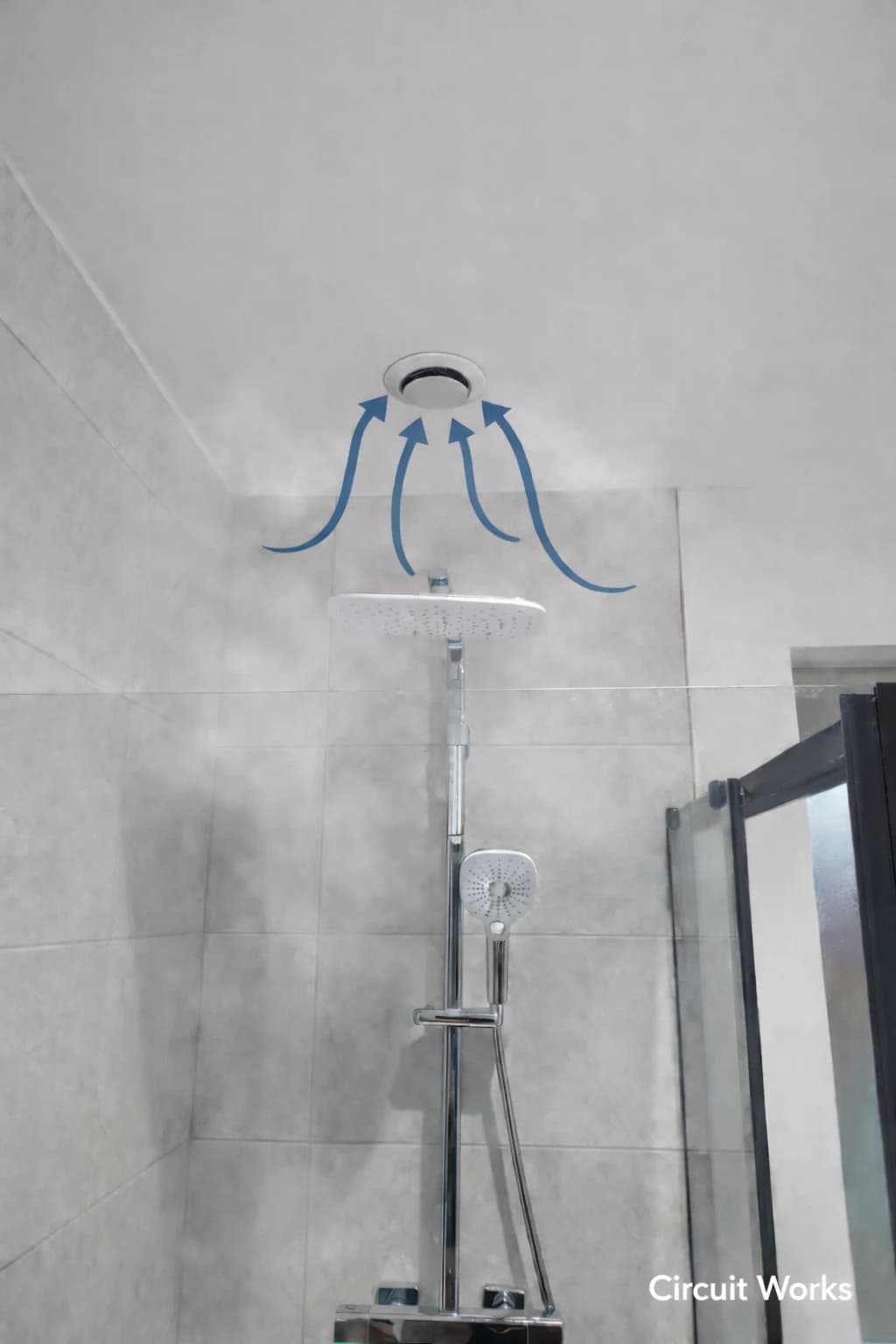
The most effective fix is to remove the moisture at the source, before it reaches cold surfaces. In a bathroom, that means a properly working extractor fan.
Opening a window helps, but most people do not leave it open long enough in winter. A good extractor fan does the job automatically.
It also helps to keep the door closed while showering, wipe down tiles and glass afterwards, and keep the room reasonably warm, as warmer surfaces are less likely to get condensation.
What Extract Rate Does a Bathroom Fan Need?
Building Regulations guidance in England (Approved Document F, Volume 1) sets minimum extract rates for bathrooms:
- Intermittent extract fan: at least 15 litres per second
- Continuous extract system: a high rate of at least 8 litres per second
An intermittent fan is the usual type, which runs when the room is in use. The guidance also says that if a bathroom has no external walls, the fan should provide at least four air changes per hour.
The important detail is that these are the rates the fan must achieve once installed, not the figure on the box. Ducting, bends and grilles all reduce how much air a fan actually moves.
Humidistats and Run-On Timers
A lot of bathroom fans fail because they are only on while the light is on. You shower, switch the light off, and the fan stops while the room is still full of steam.
There are two common solutions:
- Run-on (overrun) timer: the fan keeps running for a set time after you switch it off or leave the room. For a bathroom with no openable window, the Building Regulations guidance says the fan should keep running for at least 15 minutes after the room is vacated
- Humidistat: a sensor that switches the fan on automatically when humidity rises, and keeps it running until the air has dried out. The guidance allows humidity controls in bathrooms, and says any automatic control should have a manual override so you can switch the fan on or off yourself
For most bathrooms we recommend a fan with a humidistat, because it deals with the moisture whether or not anyone remembers to switch it on.
Fan Placement Matters
Where the fan goes makes a real difference. Building Regulations guidance says extract fans should be fitted as high as practical, and no more than 400mm below the ceiling. Warm, wet air rises, so a fan mounted high catches it before it spreads.
Ideally, the fan should also be away from the door, so replacement air coming in under the door travels across the room to the fan. A fan right next to the door leaves the far corner damp.
Why Long Flexible Ducting Kills Performance
A common fault we find is a decent fan connected to a long run of flexible ducting across the loft.
Flexible ducting has a ribbed inside surface that creates a lot of resistance. Long runs sag, kink and bend, and every bend makes it worse, so very little air actually leaves the house. In a cold loft, moisture can also condense inside the duct and run back towards the fan.
The current Building Regulations guidance says:
- Rigid ducting should be used wherever possible
- Flexible ducting should only be used for final connections, with a maximum length of 1.5 metres, pulled taut
- Duct length and the number of bends should be kept to a minimum
A new 2026 edition of the guidance, which takes effect on 24 March 2027, tightens this further. It limits flexible ducting to 200mm for final connections, and expects rigid duct runs to be no more than 2 metres where practical.
If your fan is noisy but does not clear the steam, suspect the ducting.
IP Ratings and Bathroom Zones
Bathrooms are split into zones based on how close they are to water.
For fans and other equipment in zones 1 and 2 (directly above and around the bath or shower), the wiring regulations require a minimum rating of IPX4, or IPX5 where water jets are likely to be used for cleaning. Your electrician will choose a fan suitable for its position. Our guide to IP ratings explained in plain English covers what the numbers mean.
Fitting a fan involves fixed wiring, so it is not a DIY job. Replacing an existing fan using the existing cabling does not need to be notified to building control. Installing a new circuit, or new electrical work close to the bath or shower, is notifiable under Part P. As NAPIT registered electricians, we handle the certification and notification for you.
When It Is Not Condensation
Not every damp patch in a bathroom is condensation. It is worth ruling out other causes, because a fan will not fix them.
It might be a leak if you see staining on the ceiling below the bathroom, damp around the bath, toilet or shower that stays wet when the room has not been used, or loose tiles and failed sealant.
It might be penetrating damp (water coming in from outside) if patches on an external wall get worse after rain rather than after showers, or there are visible problems outside such as damaged pointing, gutters or render.
If you suspect a leak, call a plumber. For penetrating damp, a builder or roofer should look at the outside of the building. Once that is sorted, good ventilation will help the room dry out and stop mould returning.
What Does a Bathroom Extractor Fan Cost?
A bathroom extractor fan with a humidistat typically costs £150 to £300 fitted, including VAT. The price depends on the fan, how easy the duct route is, and whether a new supply is needed.
If you have mould in other rooms as well, it may be a whole-house issue rather than just the bathroom. Our guide to condensation, mould and ventilation solutions explains the options, including positive input ventilation. You can also see our condensation and mould prevention service.
Frequently Asked Questions
Get a Quote
If you are tired of scrubbing the same mould every few weeks, a properly fitted humidistat fan is usually the fix. Get a quote for a bathroom extractor fan, or contact us to talk through the problem. We cover Pontefract, Wakefield, Leeds and the surrounding areas.
Have a question about your job?
Send us the details and we'll get back to you within 2 hours during working hours. We cover Pontefract, the Five Towns and West Yorkshire.
Ready for a price now? Get a free quote